

Why Waiting Until Tax Season Can Hurt Your Business
Your business is growing. Revenue is increasing. Customers are paying. The bank balance seems healthy enough; things are moving in the right direction. So you hire a couple more employees and finally purchase that piece of equipment you have been putting off. At first, everything still seems fine. Then slowly, cash starts getting tighter.
Expenses begin growing faster than expected. Vendor payments start getting delayed just to manage timing. As revenue grows, the pressure somehow gets worse instead of better. Eventually, you are forced to start deciding which bills get paid first. And at some point, you miss payroll.
The problem is that revenue alone does not tell you whether a business is financially healthy. That is where reactive accounting becomes dangerous.
Many growing businesses rely on budgets without true cash flow visibility. Proper cash flow forecasting helps identify problems before they become crises. We break this down further in our blog: cash flow forecasting vs. budgeting.
The Problem With Traditional Accounting
Traditional accounting is largely built around looking backward. For many businesses, the relationship with their accountant revolves around tax filings, year-end financial statements, and compliance deadlines. Once those items are completed, communication becomes minimal until the next reporting cycle.
Compliance work is important. But, too many accounting relationships stop there. If accountants are not actively helping business owners make decisions, they are missing the most valuable part of their role.
We regularly meet business owners who are surprised when we explain that financial reporting should be shaping operational decisions. Many have never experienced accounting as anything beyond filing taxes and reviewing historical numbers after the fact.
The issue is that reactive accounting often identifies problems only after they have already started impacting the business. By the time owners realize margins are shrinking, cash flow is deteriorating, or operational costs are becoming unsustainable, they usually have fewer options available to fix the problem cleanly.
Reactive accounting explains what happened. Proactive accounting helps businesses understand what is happening while they still have time to respond strategically.
What Is Proactive Accounting?
Proactive accounting is a forward-looking approach to accounting focused on helping business owners make better decisions before financial issues become serious problems.
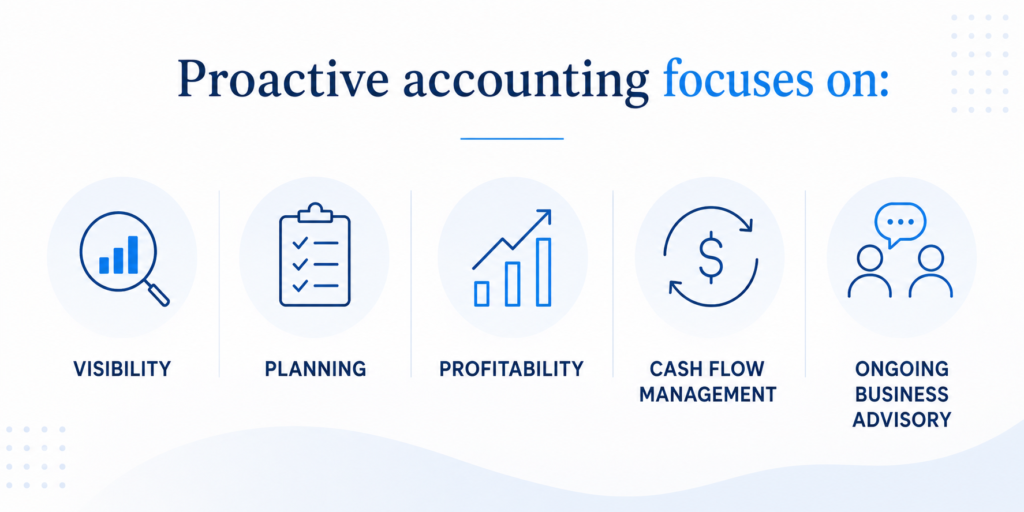
The goal is not simply to produce financial statements. The goal is to help business owners understand the financial story behind the business while decisions are still being made. That changes the relationship entirely.
Instead of hearing from your accountant once a year, proactive accounting creates an ongoing partnership focused on helping the business move in the right direction financially. That visibility becomes much more powerful when business owners receive consistent, reliable financial reporting throughout the year. We break this down further in our blog: Why Monthly Financials Give Businesses an Unfair Advantage.
As businesses evolve, their financial needs evolve too. Hiring decisions, expansion plans, operational changes, and growth strategies all have financial consequences, and proactive accounting helps owners understand those consequences before they commit to major decisions. Most importantly, it helps eliminate surprises.
A Real Example of Proactive Accounting in Action
One business owner came to us running a $5 million HVAC company. From the outside, the business looked healthy. Revenue was steady, work was coming in consistently, and operations appeared busy.
But the owner knew something felt wrong. Cash flow was getting tighter, yet nobody could clearly explain why. The issue was not demand; it was visibility.
The financial statements were largely being driven by cash movements in the bank account rather than actual business activity. Timing differences were distorting performance, and the company had very little visibility into project-level profitability, especially around labour and parts. The business was making decisions without seeing the full picture.
We rebuilt the financial reporting using Accrual Accounting and introduced project-level tracking.
For the first time, the owner could clearly see:
- which jobs were profitable
- where margins were being eroded
- and which operational areas needed adjustment
That insight changed the way the business operated. Instead of guessing, the owner could finally manage the business with intent.
Together, we developed a strategy that improved margins by approximately 5% while giving the business much clearer visibility into what expenses it could realistically afford as it continued growing. That is the real value of proactive accounting. Not just cleaner reports. Better decisions.
Why Proactive Accounting Matters for Growing Businesses
One of the biggest misconceptions in business is that revenue growth automatically means the company is financially healthy. We have seen businesses grow rapidly while unknowingly becoming less profitable with every new sale. More revenue was unintentionally digging the business into a deeper hole.
That is why financial visibility matters. As businesses become more complex, owners need visibility into profitability, cash flow, and operational trends early enough to make informed decisions before problems become expensive. This is where strong Financial Controller Services can become critical for growing businesses.
Final Thoughts
The businesses that survive and grow long term are the businesses with the clearest financial visibility and the ability to make informed decisions before problems escalate.
That is the real advantage of proactive accounting. It is not just about compliance or bookkeeping. It is about helping business owners understand what is happening financially while they still have options. Because by the time most entrepreneurs realize something is wrong, the warning signs were usually there long before.
Most accountants show up once a year. We show up every month.
If you want better financial visibility and a more proactive approach to accounting, learn more about our full-service accounting and advisory solutions at Vistance Accounting.