
A Year-end Report Card: By Daryl Ching
Mark Carney’s government has made progress on small-business promises, but a soaring deficit and shaky U.S. trade relations threaten to undo the gains.
OTTAWA – A Balancing Act Between Promises and Prudence
On Canada’s election day – April 28, BNN Bloomberg invited me on the show: The Open, as a small business expert to ask me what I was hoping a new government would do for small businesses. I discussed five things that small businesses would want to see from a new government. If you want a memory refresher, video below:
How was the Liberal government’s first year in office so far? Let’s get on with the report card.
Prime Minister Mark Carney’s first federal budget offers a complex picture for small-business owners. On paper, several Canada Strong commitments are being implemented. In practice, the fiscal path and geopolitical headwinds may soon test the government’s ability to keep them.
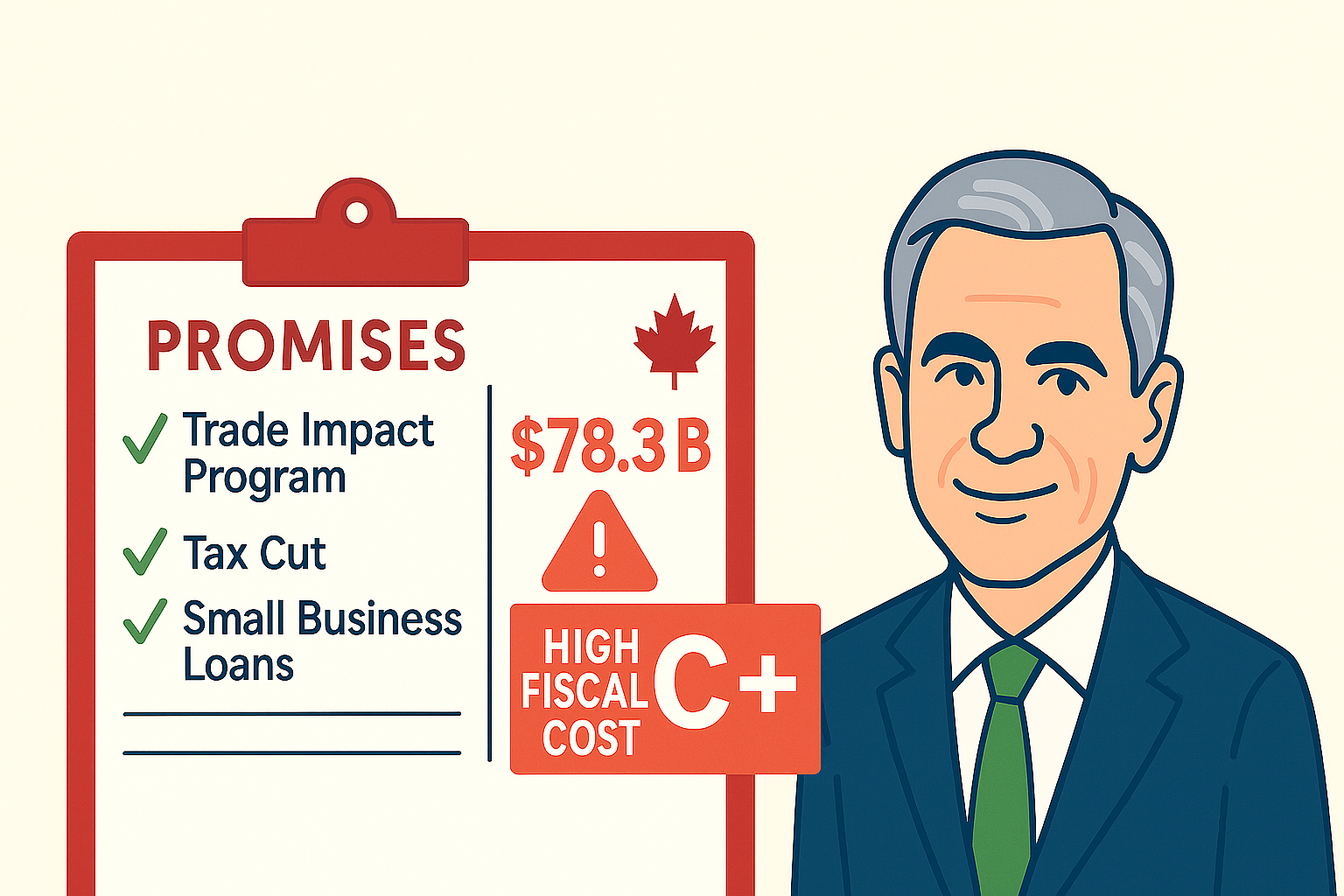
The $78.3 billion deficit projected for 2025–26, roughly 2.4% of GDP, is the highest since the pandemic. With interest payments exceeding $49 billion annually, fiscal anchors have effectively been loosened. The central question now: can Ottawa keep its promises without sinking its credibility?
There is, however, a silver lining. Mark Carney brings to the table a level of economic credibility and institutional experience that his predecessor, Justin Trudeau, often lacked in the eyes of markets and business leaders. If he can restore confidence to bring investors back into Canada, there is a glimmer of hope.
Small-Business Report Card (2025)
| Promise | Status | Grade | Commentary |
| 1. $6.5B Trade Impact Program | Implemented, partial rollout | A- | Structure matches campaign commitment: $5B for exporters, $1B for agriculture, $500M in loans. Execution timelines remain opaque, but funding is in place. |
| 2. Trade Diversification & Infrastructure Investment | Significant progress | A | $36–50B for ports, rail, and trade corridors to reduce U.S. dependence. Tangible and transformative for exporters if sustained. |
| 3. Expanding Global Trade Partnerships | In progress | B- | Diplomatic engagement with ASEAN, Latin America, and CANZUK ongoing. No finalized trade deals yet. |
| 4. Middle-Class Tax Cut (1% reduction) | Completed pre-budget | A | Lowered lowest bracket from 15% to 14%. Direct benefit for wage-earning entrepreneurs and incorporated SMEs. |
| 5. Eliminating Internal Trade Barriers | Policy stage | B- | “One Canadian Market Initiative” announced ($150M over five years). Early stage; long-term potential is high. |
| 6. Workforce Development & Skilled Trades Investment | Partial delivery | B | $600M+ allocated for training and credential programs, but the $8K apprenticeship and $15K upskilling benefits remain unfunded. |
| Fiscal Management (overall) | D+ | D+ | Deficit ballooned to $78.3B, debt ratio rising through 2026. Fiscal pressure threatens sustainability of SME programs. |
Composite Grade: C+
Four of six promises are either delivered or well underway, but the deteriorating fiscal picture drags the overall score down. The deficit, now Canada’s fiscal “elephant in the room,” undercuts the government’s long-term credibility with entrepreneurs and investors alike.
Negotiating the Tariff Tightrope
Carney’s agenda continues to be shaped by the U.S. tariff dispute, which has strained Canadian exporters since early 2025. Carney has reversed course from the original “Elbows Up” approach that got him elected to quiet diplomacy, after the US secured trade partners in Europe and Asia, as he wants to avoid having Canada left in the cold.
Talks are ongoing for a North American Trade Stability Framework, designed to prevent sudden tariff shocks across key sectors. The Prime Minister has emphasized “economic security through engagement,” but with U.S. protectionism intensifying, leverage remains limited.
For now, that balance appears to hold, but the fiscal cost of maintaining it is rising fast.
The Deficit Dilemma
Carney’s credibility as a former central banker is being tested. The budget’s massive shortfall highlights the tension between stimulus and sustainability. Economists warn Canada’s debt-to-GDP ratio could climb two points by 2026, shrinking fiscal room for future investment and forcing hard choices on tax policy or program spending. For SMEs, that translates to uncertainty: will today’s supports survive tomorrow’s belt-tightening?
SME’s at a Crossroads
In the near term, Carney’s programs offer lifelines: export support, infrastructure funding, and training initiatives that buy time for recovery. But Canada’s entrepreneurs are already asking how long that time will last. With fiscal pressures mounting and U.S. trade uncertainty lingering, the risk of policy reversal is rising. Carney’s task is no longer just managing spending; it’s restoring trust, at home and abroad.
The Wildcard: Restoring Confidence
The true test for Carney’s economic plan is not in budget tables or parliamentary votes; it’s in whether he can reignite private investment in Canada. Business confidence remains fragile. Capital flows that once favoured Canada’s resource, manufacturing, and tech sectors have drifted south as investors seek stability and scale.
If Carney can restore faith in Canada’s economic direction, he could pull off a rare feat: stimulating growth while re-anchoring confidence. If he fails, the deficit won’t just be a number; it will be a warning sign that Canada’s era of fiscal credibility is slipping away.
Yet amid the fiscal fog, one silver lining remains: Mark Carney himself. Unlike Trudeau, Carney carries hard-earned credibility from his years steering central banks through crises. Markets still see him as a pragmatist, not an ideologue. If he can summon that discipline in Ottawa, he might just steady the ship, and prove that experience, not politics, is what restores confidence in Canada.
The irony is stark: a government elected on stability may find its fate decided by the markets it seeks to reassure.